A perfect lazy Sunday in Singapore looks like this: the sea before seven, kaya toast at a hundred-year-old kopitiam, one pastel street taken slowly, laksa eaten with a spoon, and — once the heat breaks — a picnic under a tree with nowhere to be.
That is the whole itinerary. It fits in a sentence because nothing on it needs managing.
Here is the part the fitness accounts leave out: that lazy afternoon is quietly doing more for how you look and sleep than yesterday's workout did. You cannot out-train, out-diet, or out-juice a nervous system that never switches off. The one thing that brings it down is actually stopping — and a slow Sunday is where you practise.
I should admit I am not a natural. I am the 5:15 guy — gym check-in at 5:15 every morning, timestamp on the story as receipt — and my week runs on a schedule the way a train does. Sunday still gets timestamps, because old habits are old habits. But I have learned to take the agenda out of the hours. What follows is my actual Sunday, in the east where I do it. Hold it loosely. The times are a trellis, not a cage.
6:50am — East Coast Park, before the island wakes
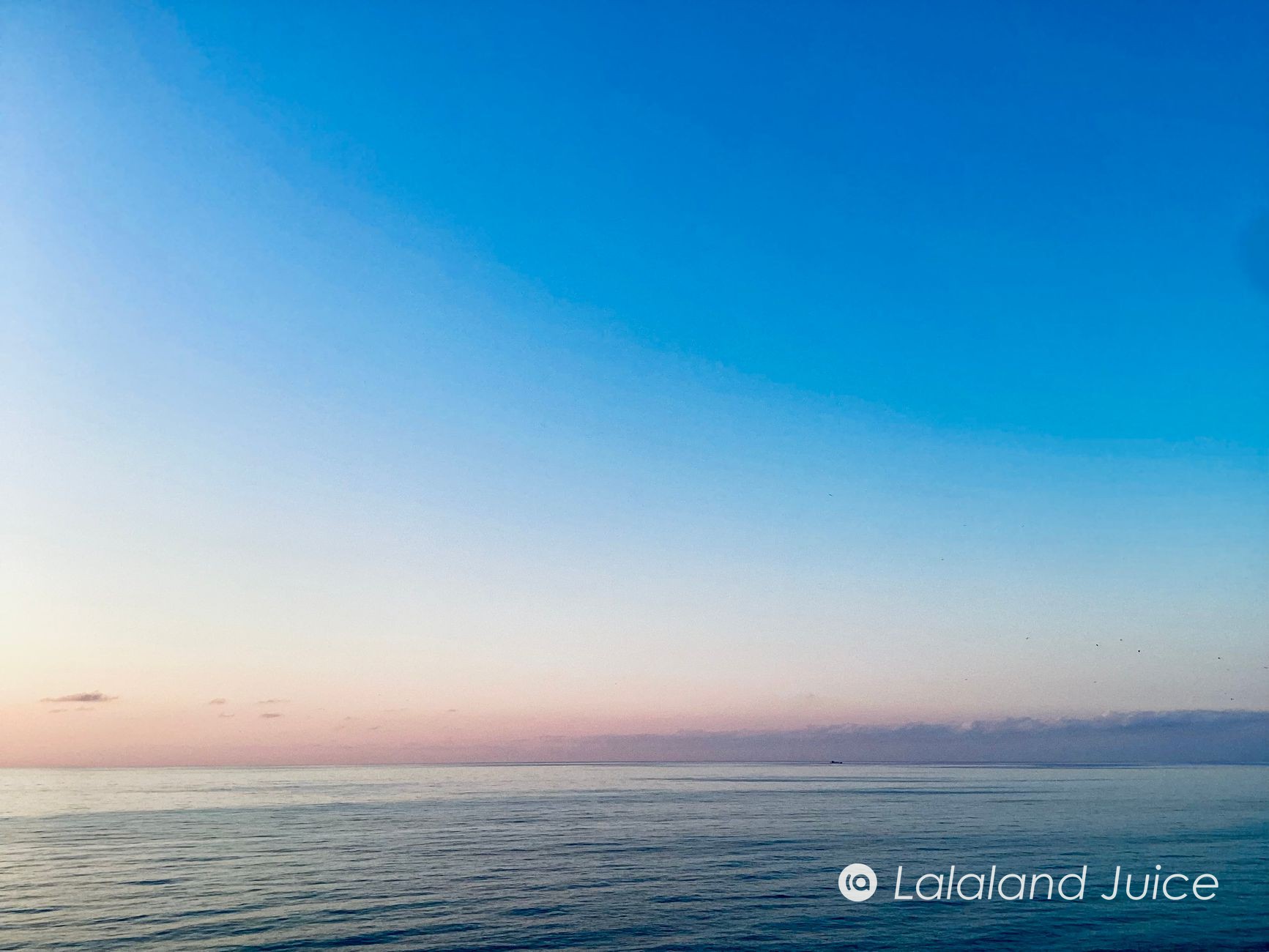
The sun comes up at 7:06 this time of year [2], and I like to be on the sand a few minutes before it, while the sky is still deciding what colour to be.
East Coast Park never closes — 180 hectares along 13 kilometres of coast, open 24 hours [1] — but at this hour it belongs to almost nobody. One jogger. One uncle with a rod. Container ships strung along the horizon, going nowhere in particular, same as me.
There is a reason I open the lazy day with the brightest thing available. Morning light is the signal that sets your body clock, and your body clock is what decides, sixteen hours from now, whether you drop off easily or lie there wiring. In one study, office workers who sat near a window took in more daylight and slept, on average, about 46 minutes longer each night than colleagues without one [15]. If you have ever wondered why you can't sleep, the honest first answer is often this: you never really went outside.
On a weekday I would be mid-set by now. Here, the only check-in is the horizon. I bring no earphones and nothing to read. The tide keeps its own time, and for one hour, so do I.
8:15am — kaya toast at a kopitiam older than the country
By eight the walk has turned into an appetite, and Katong, conveniently, sits just inland.
Chin Mee Chin has stood at 204 East Coast Road since 1925 — it turned one hundred last year — and opens its doors at eight each morning [3]. Kaya toast, a kopi, a seat under the fan. The smell of a working bakery does more for a Sunday than any alarm has ever done for a Monday.
I used to eat breakfast one-handed, thumb on the phone. Here I keep one hand for the toast and one for the cup, which turns out to be the correct number of hands.
10:00am — the long way down Koon Seng Road
The neighbourhood itself is the second course. Katong drifts into Joo Chiat, named Singapore's first Heritage Town in 2011 [4], and through the middle of it runs the street everyone photographs and nobody finishes photographing: Koon Seng Road, its shophouses built by Peranakan families a century ago and conserved since [4].
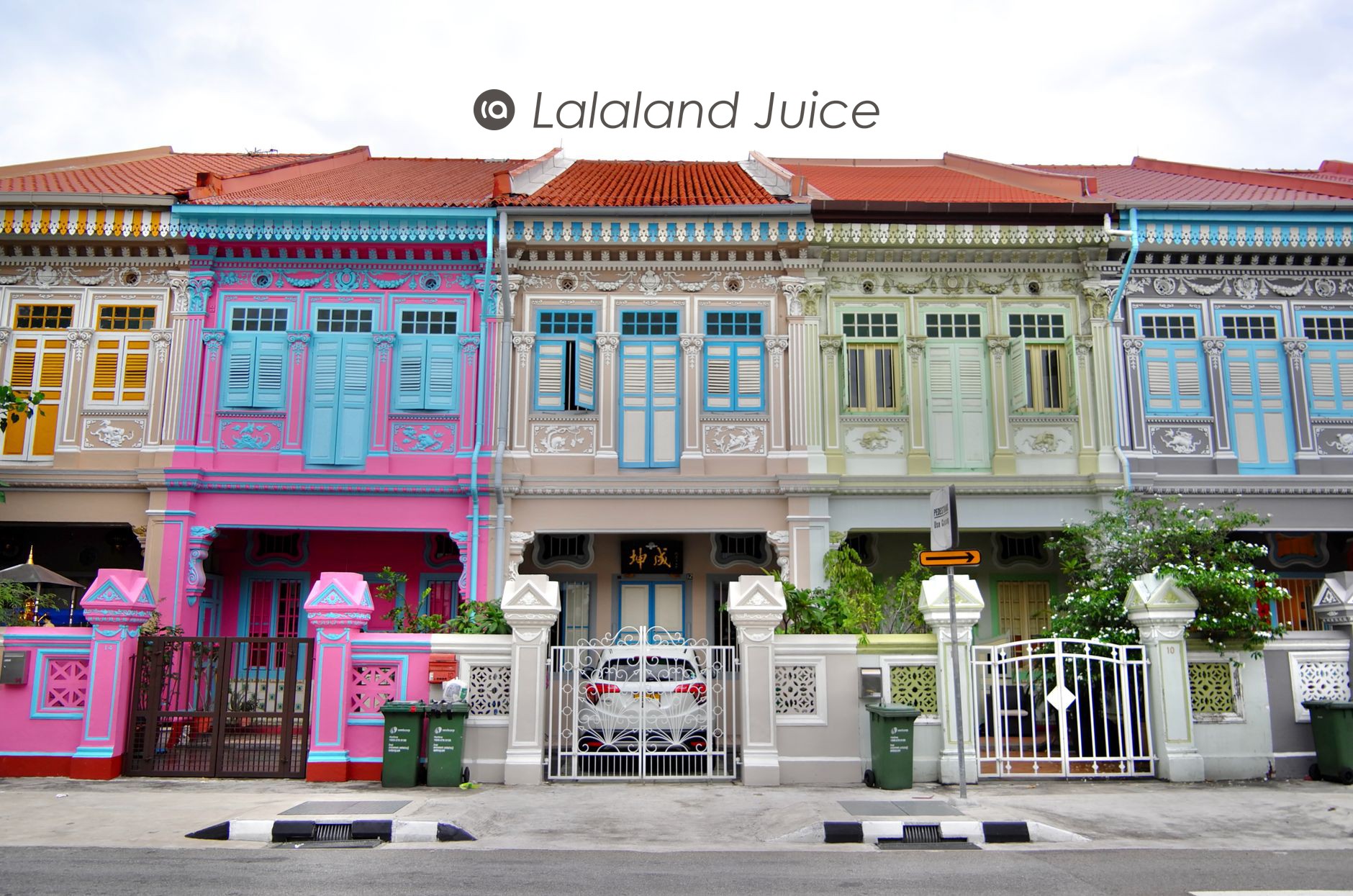
Walk it slower than you need to. The details are the point — the tiles, the shutters, the plaster flowers in colours somebody once argued over at a family table. You are also, without trying, banking the two things that make a night's sleep easy: daylight and a little movement. A gentle walk is not training; a review of the studies finds regular movement measurably improves how well people sleep, and it counts anyway [17].
I used to need a destination before I would walk anywhere. This hour is where I unlearned that. You are not going somewhere. You are just going.
12:30pm — laksa, one spoon, no decisions
All that drifting ends, as it should, in laksa.
At 328 Katong Laksa on East Coast Road, the noodles arrive already cut short, and you eat with a spoon — no chopsticks, none needed [5]. This is the stall that famously took a public tasting against Gordon Ramsay in 2013 and won [5], but I love it for a quieter reason: there is nothing to manage. No portioning, no twirling, no choices. Spoon, gravy, repeat.
For a man who plans everything, being left with no decisions is a holiday in itself.
2:00pm — "cortisol face," and the thing no gym can fix
I need to tell you about a beach, because it is the reason I understand the rest of this day.
A few years ago, a beach day with the usual crew. Every other guy peeled his shirt off without a thought. I — the one who trained hardest of all of them, the 5:15 guy — kept mine on. After all that discipline, I still was not sure how I looked.
Then the question, fair and stinging: you train so hard, why do you still look puffy? Where did the abs go?
The answer was not more training. It was cortisol — the stress hormone your body releases when it believes you are still under threat, which, if you never switch off, is more or less always.
This is the honest version of the "cortisol face" and "cortisol belly" you have seen going viral. The viral version oversells it: a round face is not a disease you cure with a supplement, and everyday puffiness is more often just too little sleep or too much salt.
But the kernel is real. Doctors confirm that genuinely, chronically raised cortisol can round the face and pad the middle — the abdomen and the face are exactly where the body likes to park that fat [10]. Researchers have found that people who pour out more cortisol under stress carry more of their fat centrally, around the organs [9]. And it does not stop at the mirror: high cortisol tilts your appetite toward fatty, sugary food and quietly frays your sleep [11].
So here is the sentence that took me years and one beach to learn: you cannot out-train, out-diet, or out-juice a switched-on nervous system. If the body is convinced the week is still on, it holds on to everything — the water, the fat, the tension — no matter how clean your macros are.
The only thing that talks a nervous system down is the thing I was worst at. Stopping. Which is what the rest of this day is for.
3:30pm — the hottest hour, spent horizontal
By the time the bowl is empty, the afternoon outside has turned up the dial. Singapore days peak between 31 and 33 degrees [6]. You can argue with that, or you can go home, put the fan on, and lie down. I no longer argue.
There is a saying in the gym that getting into shape is "three parts gym, seven parts diet, and ninety parts sleep." The maths is nonsense on purpose. The direction is not.
When researchers put dieters on identical calories but cut their sleep from 8.5 hours to 5.5, the short-sleepers lost 55 per cent less fat — and 60 per cent more muscle — than the well-rested ones [7]. Same diet. Sleep alone decided whether the body gave up the fat they wanted gone or the muscle they were breaking themselves in the gym to keep.
Sleep runs your hunger, too. Cut it, and leptin — the hormone that says "you're full" — falls about 18 per cent, while ghrelin, the one that says "eat," climbs 28 per cent, and appetite with it [8]. The 3pm craving is not weakness. It is a tired body asking for what the night should have given it.
This is the hour I used to fill first — errands, admin, a quick look at Monday. Now it is the hour I guard hardest, because rest is not the reward for the work; it is the other half of it. This is the part of learning how to rest that nobody teaches.
It took me years to draw the ladder that finally made sense of it: working hard matters less than a good diet, which matters less than good sleep, which matters less than keeping your cortisol down — and above all of it, the rung I still find hardest, is learning how to shut down and simply feel.
But you cannot simply order better sleep, or lie in a dark room willing it to arrive. The fix is rarely another supplement or pill. It is out there, in the daylight — which is why the day cannot end on this sofa.
5:00pm — the picnic: the whole point of the day
Around five, the fan has done its work and the light outside has traded white for honey. This is when I pack a basket. The picnic is the part of the day that looks like doing nothing and is, quietly, the engine of the whole thing.
Here is the chain, start to finish. No daylight and no movement all day means a weak signal to your body clock, which means poor sleep tonight, which means higher cortisol tomorrow, which means the puffy, wired, plateaued feeling you have been trying to train away. A picnic mends every link at once. You go outside. You move a little. You sit under a tree and do nothing — and doing nothing under a tree turns out to be measurable.
The Japanese have a word for it: shinrin-yoku, "forest bathing" — no swimming involved, just being among trees and paying attention. In the field studies, people who spent time in a forest rather than the city measured cortisol about 12 per cent lower [14].
You do not need a forest. One study found that just twenty minutes in a park — the sweet spot was twenty to thirty — produced the steepest drop in the stress hormone for the time spent [12]. Another, across nearly twenty thousand people, found that two hours a week in nature was the threshold where health and wellbeing reliably improved, whether you took it in one sitting or several [13]. A Sunday picnic is a third of your week's dose in a single lie-down.
Singapore makes this easy. You are never far from a good tree. East Coast Park has its casuarinas and the sea breeze; the Singapore Botanic Gardens — a UNESCO World Heritage Site since 2015, open 5am to midnight — keeps a six-hectare stand of primary rainforest older than the Gardens themselves [19]. Fort Canning and Labrador do the shade-and-lawn thing beautifully too. Any of them is a better prescription for tonight's sleep than anything sold in a bottle to swallow before bed.
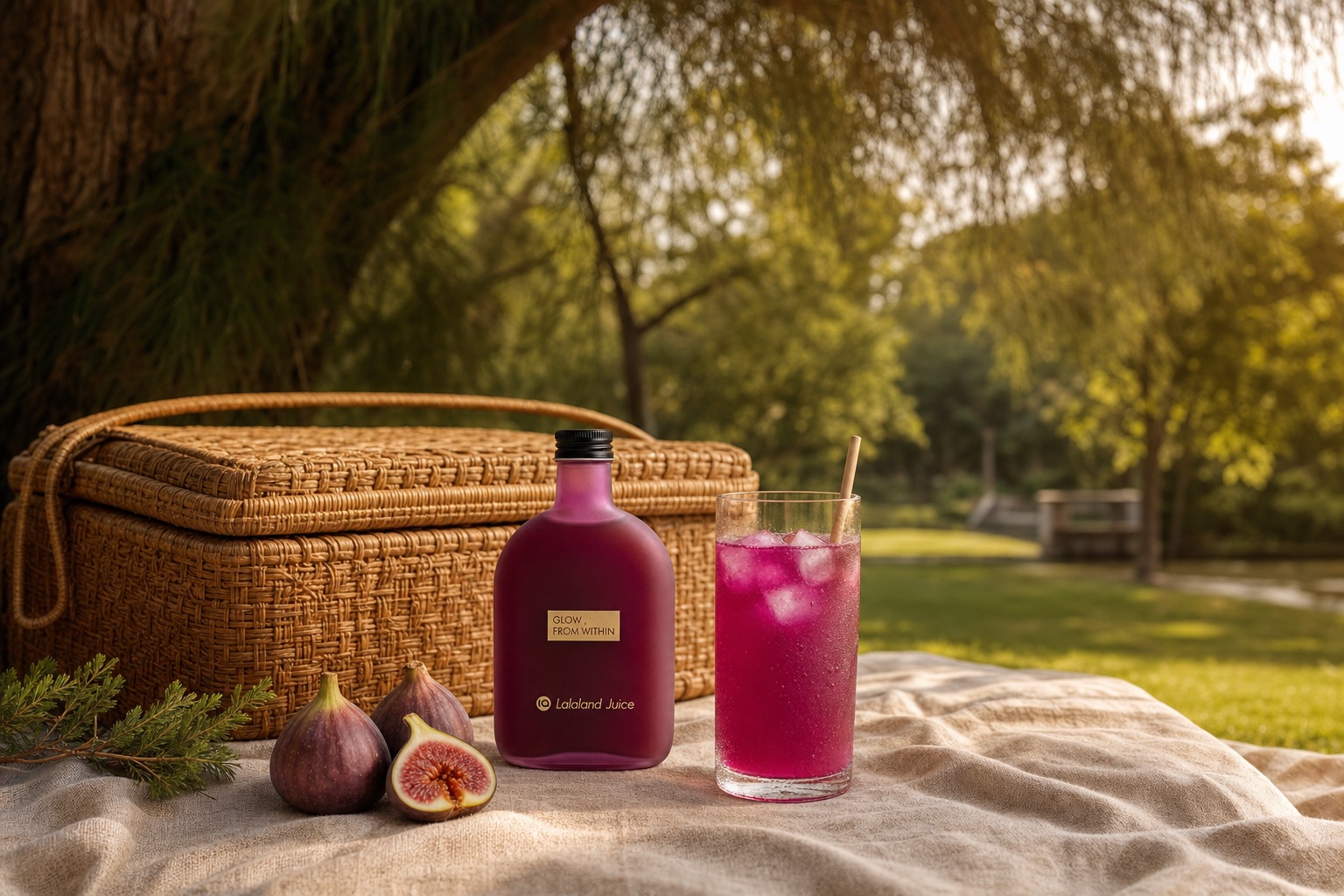
Which brings me to the one bottle I do bring. Around now the cold-pressed juice comes out of the basket, fogged from the fridge — mine is Model Glow: beetroot, pineapple and apple, cold-pressed here in Singapore, no added sugar.
Let me be precise about its job, because it is easy to romanticise. The sitting-under-the-tree is what settles the cortisol; the walk here banked the daylight. The juice is the excuse — the small, pleasurable reason to pack the basket and actually go. A naturally pink drink you rest with, not a bright pink one you run on.
That is the honest difference, if you have been hunting for a Starbucks Pink Drink alternative in Singapore. The famous pink one is built to keep you switched on: a grande carries about 45 milligrams of caffeine, from green coffee extract, and roughly 24 grams of sugar [18]. Perfect for a Monday you have to power through. Wrong tool for a Sunday you are trying to power down. Nature, not caffeine — you cannot come down on a stimulant, and coming down is the entire point of the afternoon.
7:15pm — sunset, and the border of the day
The one fixture of the day keeps itself: sunset, 7:15 [2]. This close to the equator we are dealt the same hand daily — about twelve hours of light, every day of the year [2][6] — so a Sunday never runs long or short. You always get the full measure.
There is one more quiet reason to still be outside as the light goes. The same natural light-and-dark that woke you gently is now telling the body that night is coming. When researchers sent people camping for a week with only daylight and firelight, their sleep hormone began to rise nearly two hours earlier — closer to sunset — and their body clocks reset almost completely [16]. You do not need a tent. You need a sunrise and a sunset your eyes actually see, and today you have banked both.
Dinner is whatever is nearest and simplest. Then the small honesty: the gym bag gets packed by the door, because Monday's 5:15 does not miss. But the laptop stays shut. Monday can introduce itself when it arrives.
The last of the light goes out over the park where the day began. I used to think a day had to show receipts. This one closes with none — twelve hours, spent rather than invested, and the richest I feel all week.
Outside, the tide is coming back in. Tomorrow has a timestamp. Tonight does not.